


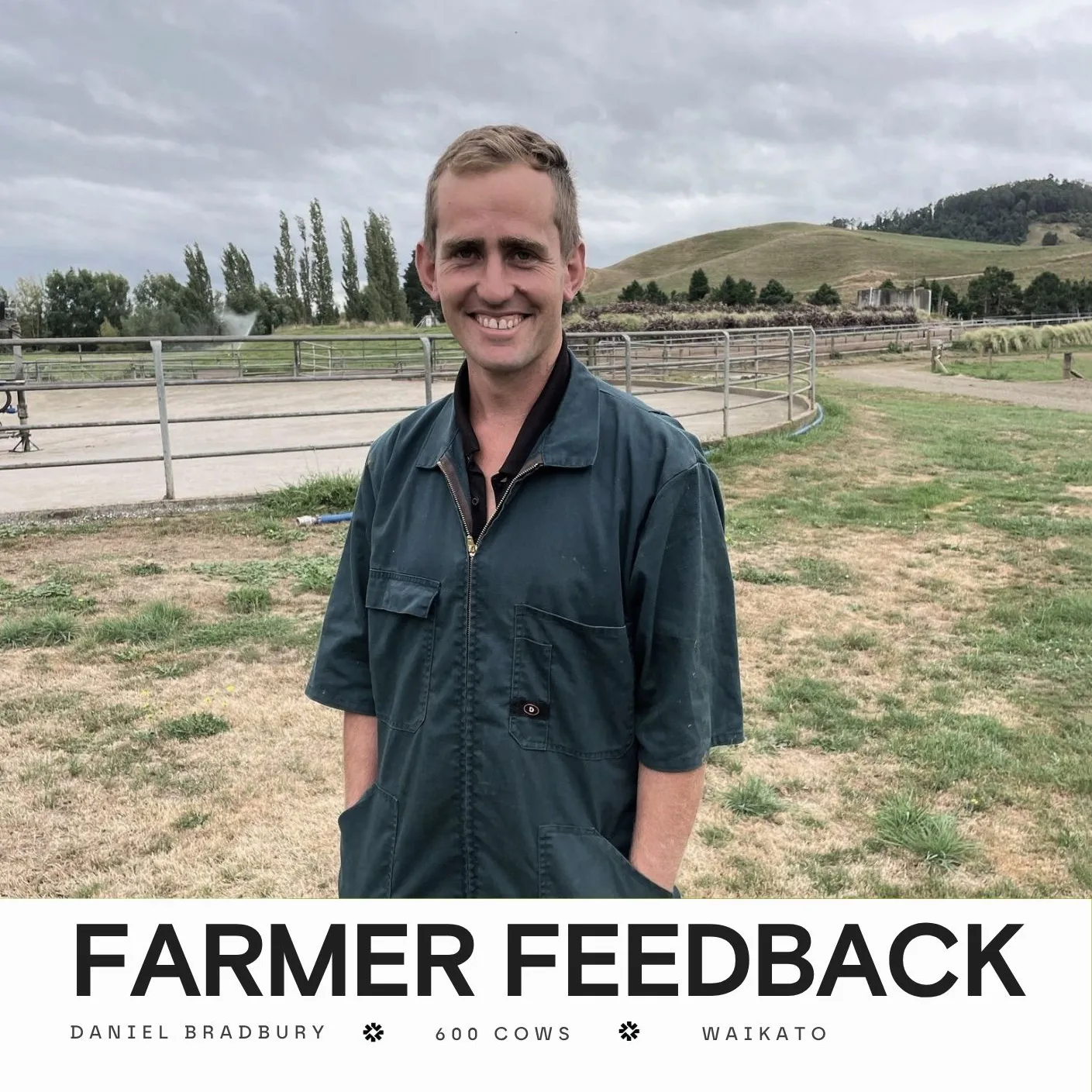
Daniel Bradbury — 600 Cows, Waikato
For the last three seasons, Daniel Bradbury has been 50/50 share milking 600 cows on a 173-hectare farm between Te Awamutu and Otorohanga, in the Kōrakonui area. Operating a System 4 farm, Daniel prioritises efficiency, with cow health playing a key role in measuring overall success.
For Daniel, cow lameness isn’t just another on-farm challenge — it’s an area he’s long taken a personal interest in.
“Back when we were contract milking, we actually got to a bit of a crossroads. We were deciding whether to move into a share milking role or whether I’d go out as a professional hoof trimmer. So, lameness has always been something that interested me.”
That interest is what first drew him to Herd-i.
“We saw Herd-i at Fieldays when it first came out, and it immediately piqued our interest. And as we’ve grown and the herd has got bigger, we’ve increasingly seen the value of having it as a useful tool.”
Catching the Cows That Are “Just Slightly Off”
Like many farmers, Daniel says the real challenge isn’t spotting obviously lame cows — it’s identifying the early signs before they escalate.
“It’s those cows that are just slightly off, not properly lame, but not quite right either. That 1–1.5 lameness score where something’s developing.”
In a busy, large-scale system, those subtle changes are easy to miss.
“A cow will naturally hide the fact she’s lame until she can’t. So if we can pick up those slight changes earlier and deal with them, we reduce the overall impact on the cow.”
That’s where Herd-i has made the biggest difference.
“Any time you can pick something up earlier, there has to be a win. If we can get those cows trimmed and back under a 1 score, that’s a big win.”
Complete Consistency, Every Milking
With Herd-i monitoring every cow as they pass through the shed, Daniel says the system provides something that’s hard to achieve manually — complete consistency.
“It just allows you to know that nothing is falling through the gaps.”
The technology acts as an extra layer of confidence, particularly on a farm where not every cow is observed walking to the shed.
“Herd-i is especially useful if, like us, you aren’t following your cows to the shed every day. We use a batt-latch for an auto-gate release, so the cows walk in at their own pace — so you don’t always see when a cow starts to slip back or slow down. This gives you that reassurance that nothing is being missed.”
Simple to Install, Runs in the Background
For Daniel, another key advantage has been how easy the technology was to install.
“It was pretty straightforward. It integrated with our Protrack EID reader, and then it was just installing the cameras and making sure all our ear tags were up to date.”
Once installed, the system runs automatically — no manual data entry required.
“We don’t have to put any data into it. It pulls all the cow numbers straight from MINDA, and that just happens automatically.”
More Than Just Lameness Detection
While Daniel’s primary interest was lameness detection, he’s found additional uses for the cameras.
“I’ve actually used the Herd-i videos to check on bulling cows. If we’ve had a heat alert from our smaXtech bolus and weren’t quite sure if it was genuine, you can look at the video footage and check for rub marks.”
It’s a practical, unexpected benefit that adds another layer of insight.
From Reactive to Proactive
At its core, Herd-i allows Daniel and his team to shift their approach from reactive to proactive.
“If we can address issues earlier, we reduce the impact on the cow and hopefully hold milk production for longer. It’s about detecting issues while they’re still minor — you’re always better off dealing with it early than waiting until it becomes a bigger problem.”
In a high-input system, those small improvements quickly compound.
Body Condition Scoring: Data That Backs Up What You’re Seeing
Beyond lameness, Daniel sees clear value in how Herd-i’s body condition scoring (BCS) data contributes to farm decision-making.
“The body condition scoring system was only up and running about a month before mating. However, we did notice that when the vet was checking the non-cycling cows, they were consistently flagged by Herd-i as having lower body condition scores. They were all the lighter-conditioned cows, which really reinforced the value of having that data to back up what we were seeing.”
Looking ahead, he sees a real opportunity in having more regular BCS information earlier in the season.
“Having that data earlier next season will be really valuable to help minimise condition loss through calving and identify cows that need extra support. Whether that’s once-a-day milking, preferential feeding, or another strategy, it gives us the chance to intervene sooner. Ultimately, that means more cows cycling on their own without intervention, helping to tighten the calving spread and create positive flow-on effects right across the system.”
Those flow-on effects, he adds, “ultimately drive gains that contribute directly to profitability.”
Objective, Repeatable Data — Every Day
For Daniel, one of the standout benefits is the consistency the technology brings. Regardless of who is on-farm or in the shed, the data remains objective and reliable.
“A lame cow is a lame cow, and a light cow is a light cow. There’s no interpretation needed by a person — it’s the same reading day in, day out.”
That consistency gives him confidence that decisions are being made on accurate, repeatable information, helping remove human bias and ensuring no cow slips through the cracks.
And in a system where margins and performance matter, those small gains are significant.
“It’s about picking things up earlier and dealing with them quicker. That’s where the real value is.”
“You’ve got smart tech looking at every cow, every milking, and picking up those small changes — that’s where the value is.”
— Daniel Bradbury, 600-cow share milker, Waikato