


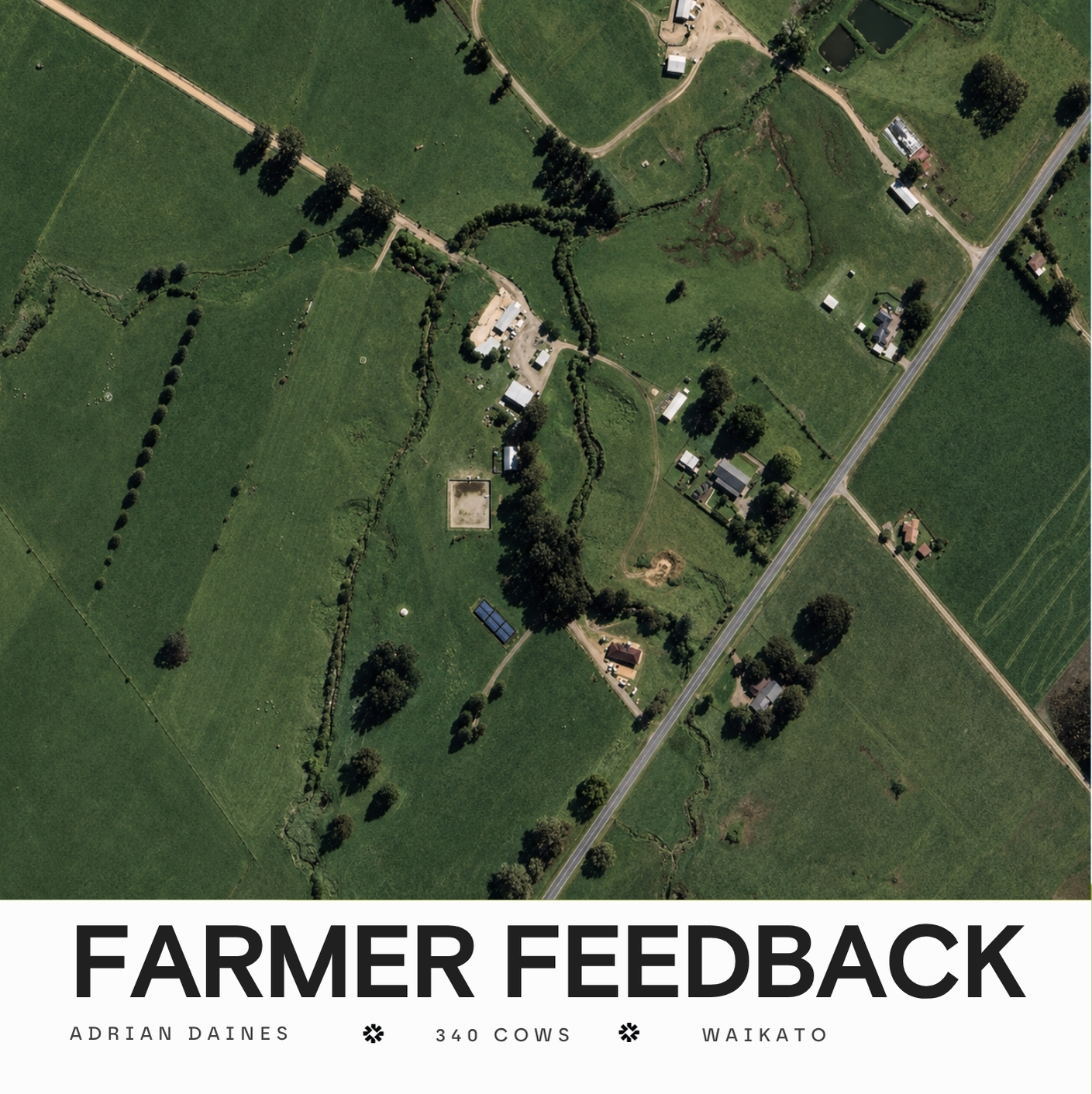
FARMER FEEDBACK ADRIAN DAINES — 340 COWS — WAIKATO
For Adrian Daines, the decision to use Herd-i came down to one thing: clarity. Adrian and his wife are 50/50 sharemilking their 340 Friesian-cross herd in Wardville, midway between Waharoa and Matamata.
On their farm the cows take priority, having reliable insight into herd health has shifted from a “nice to have” to something he now describes as a genuine game changer.
“Just do it,” he says simply when asked what he would tell other farmers considering Herd-i.
That recommendation comes from seeing firsthand how much difference it makes to day-to-day decision making, particularly during busy and often high-pressure periods on farm, tracking how cows are performing, confirming interventions are working, and ensuring nothing is missed.
One of the biggest benefits he has found is the ability to clearly see what is happening across the herd, rather than relying solely on shed observations or assumptions.
“It’s been a real relief knowing exactly what my cows are looking like,” he says.
That relief comes from having objective data to support what is often subjective judgement made in a busy farming environment. Whether it’s body condition or lameness, Herd-i provides another layer of visibility that reduces uncertainty and supports better performance.
In practical terms, this means less guesswork and more confidence in decision making. Instead of wondering whether cows are holding condition or slipping behind, Adrian can see it clearly and respond earlier.
“It’s just good to know my cows are going the right way with condition,” he says. “Or if they’re not, I can take steps to fix it.”
Being able to track condition allows him to act before small issues become larger problems. This timing is critical, especially when it comes to reproduction, production, and seasonal flow.
Adrian notes that, like body condition scoring, the value of lameness monitoring also lies in early detection and consistent information. Although lameness is not a major issue in his herd, Herd-i has added another layer of assurance by helping him monitor subtle changes over time.
“Herd-i gives us a really clear, unbiased score,” he says. “If a cow’s lameness score starts creeping up, even slightly, we can pick that up early and deal with it.”
That objectivity removes subjectivity from decision making. Instead of relying on individual judgement or prioritising cows on the fly, the system provides a consistent reference point.
“I don’t have to second-guess it or decide which cows come first,” he says. “If they’re flagged by Herd-i, they’re flagged.”
This has made day-to-day management more efficient and ensured cows are identified and treated without delay.
With good local hoof care support nearby, action is straightforward.
“We’ve got the hoof man right opposite, so it’s not a big issue. He’s normally here within a few days to sort cows out,” he says.
Even so, earlier identification still makes a meaningful difference in outcomes and recovery.
A consistent theme in Adrian’s experience is confidence — confidence in what is happening in the herd, and confidence in making decisions without second-guessing.
That confidence carries through into wider farm management. Rather than relying solely on instinct, he now has data to support what he is seeing on farm.
“It’s a heck of a relief to know what my cows are looking like,” he says. “At the end of the day, you just want to know you’re doing right by them.”
Reproductive performance has also improved in his first season using Herd-i. Adrian recorded an 8% empty rate, down from his usual 12%, which he attributes to more targeted body condition monitoring and earlier intervention.
“Normally we sit around 12% empty, but this season we got it down to about 8%,” he says. “For the first year using Herd-i, that was a really pleasing result.”
He believes the improvement came from identifying cows needing support earlier and managing them more precisely ahead of mating.
“It meant we could be more targeted with the lighter cows,” he explains. “And get them cycling without needing intervention.”
That has also contributed to a tighter calving spread and improved overall herd performance.
“That’s the goal, getting more cows cycling on their own,” he says. “When that happens, everything else falls into place.”
The result is not just improving reproduction, but wider gains across the system, including profitability.
Another key benefit has been how Herd-i has changed dry-off decisions, particularly for his younger cows. Previously, Adrian would have followed a blanket approach.
“In the past, I would’ve just dried off all my two-year-olds first regardless of condition,” he says. “But that doesn’t always make sense.”
That approach risked losing valuable days in milk and allocating feed inefficiently.
“You could be drying off cows that are still performing well, or feeding cows that probably should’ve been dried off earlier,” he says.
Now, with daily condition data, he can take a targeted approach.
“I can see exactly where they’re at condition-wise and make a call based on that,” he says. “It just means better use of feed and keeping the right cows in milk for longer.”
“Whether it’s a high payout year or a low one, you still want to be milking cows for as long as possible. This just gives us the confidence to do that without compromising condition.”
That shift is delivering more days in milk at the tail end of the season, while ensuring feed is directed where it creates the most value.
Beyond individual cow management, Adrian also sees wider system benefits from earlier intervention and better data.
Herd-i identifies lame cows early, so they are treated sooner. It also monitors body condition scores, so cows in poorer condition can be managed sooner. Cows that are sound and in optimal condition contribute to improved overall seasonal performance. For Adrian, it all comes back to the same principle: knowing sooner allows better decisions.
That early insight doesn’t just solve individual issues; it supports smoother whole-farm performance.
When asked to sum up Herd-i, Adrian is clear.
“Just do it,” he says again. For him, the system isn’t about adding complexity; it’s about removing uncertainty and making daily decisions simpler, easier, and more reliable.
From body condition tracking through to lameness monitoring and general herd oversight, Herd-i has become another layer of support in what is a demanding environment.
“It’s just good to know what’s going on with your cows,” he says. “And if something’s not right, you can fix it before it becomes a bigger problem.”