


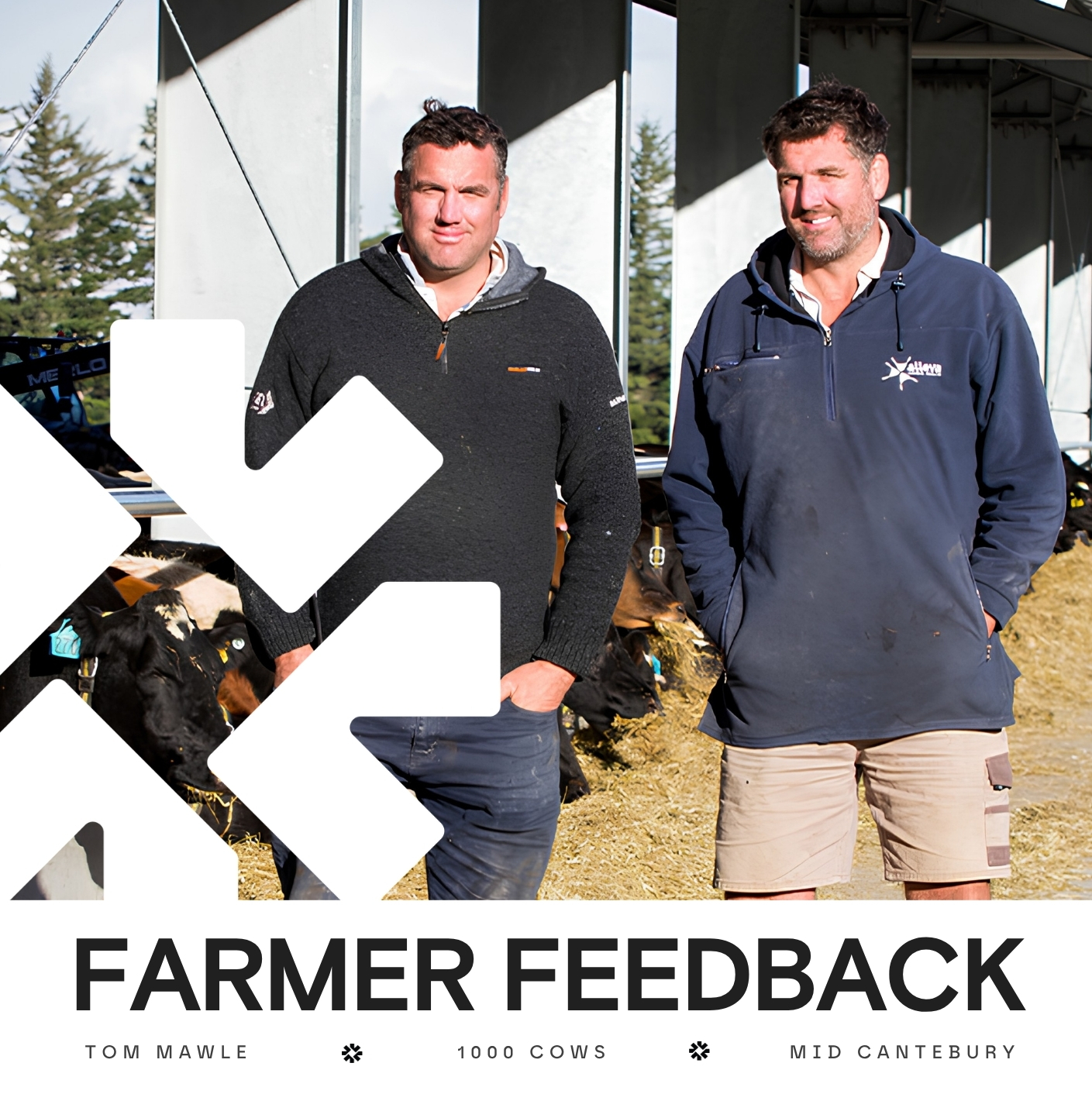
FARMER FEEDBACK TOM MAWLE — 1000 COWS — CANTERBURY
Tom Mawle has been farming the same dryland block beneath Mt Hutt for more than 15 years. Blackford Farming runs 1000 cows on a System 3 operation with no irrigation — just a reliable 1250mm of annual rainfall and a farming philosophy shaped by years in beef before dairy. Feeding cows well has always been a point of pride. But as the operation grew, Tom started thinking differently about what good management actually looks like at scale.
“For years we’ve always been a mob mentality,” he says. “We’d look at things as an average, as a group. Whereas now I think we’ve got to be way more efficient and look at individual cows on nearly a daily basis.”
That shift is what drove him to install Herd-i. Using AI-powered cameras installed in the shed, Herd-i automatically scores every cow, every time she exits the race after milking — providing early detection of lameness and daily automated Body Condition Scoring (BCS) using DairyNZ standards. For Tom, running both systems made immediate sense.
As a Synlait Lead with Pride supplier, Tom is required to complete four body condition scores throughout the year. Previously, BCS was assessed by the vet once a year in March. Now Herd-i delivers daily BCS on every cow, objectively and consistently, throughout the entire season.
With Halter also running on farm, cows are no longer being brought in by a rider at the back, making the exit race the primary observation point for both Herd-i systems.
“You’ve got eyes looking at every cow as they exit,” he says, “rather than staff sat at the back of the herd on a motorbike.”
That daily visibility changes how Tom manages condition through the season. Cows trending down in BCS get picked up early — and because he can see which ones are milking heavily off their backs, he can make informed decisions about feed management before condition slips too far. He cross-references that with rumination data from Halter to build a fuller picture, particularly through calving and mating.
On lameness, the impact has been similar: earlier detection, earlier intervention. Treating cows before issues become clinical has reduced severe cases and cut antibiotic use. Repeat offenders get identified and culled on his terms — 70 cows left the herd in good condition at $500 above standard cull price rather than as worn-out problems.
“We’ve had good condition throughout the whole year,” Tom says. “And we’ve had an increased mating rate of about 4%.”
For the team, the value is in clarity. Two of his four staff use the dashboard regularly, building watchlists and tracking recovery alongside spray-paint markings and MINDA records.
“I’ve got it at my fingertips on my phone — a visual, a case of: this cow is lame, she needs sorting,” he says. “It’s hitting us in the face.”
His advice to fellow Synlait suppliers is straightforward. “If you’re into technology and you’re into managing individual cows, it’s a great system to fine-tune what’s happening on farm. There’s always going to be a certain percentage of cows not conforming to the system for whatever reason. If you can identify them and do something about them, there’s real value in that.”