
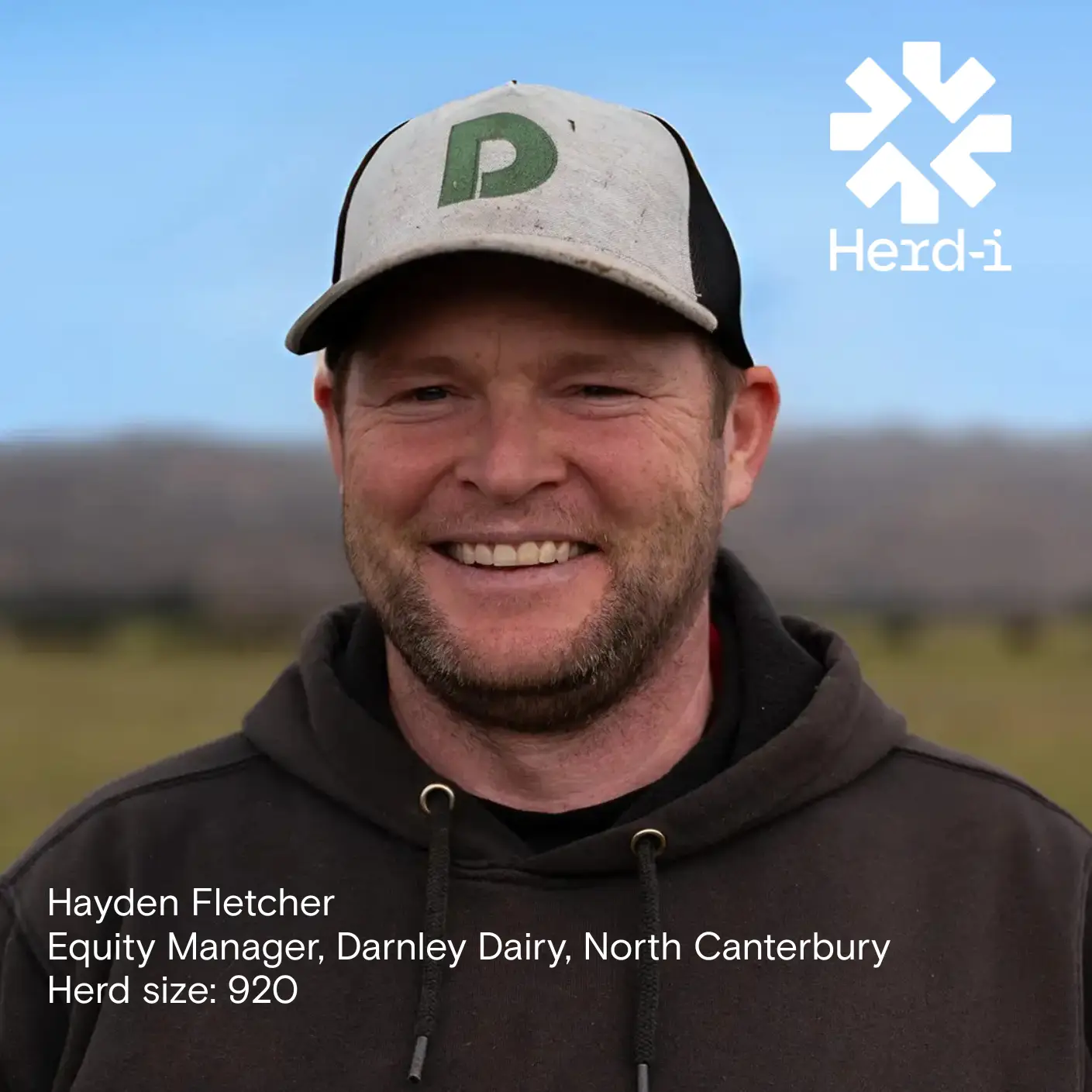
Farmer testimonial: Hayden Fletcher
Hayden Fletcher has worked with the Darnley Dairy Ltd farm operation for more than a decade, as an employer, equity partner and now operations overseer. Based in Culverden, North Canterbury this 920-cow dairy farm has been using Herd-i’s lameness system for nearly four seasons.
“When I first started on the farm, it was a 1,300-cow system with really long walks,” Hayden explains. “At that scale, lameness was a big issue. On top of that, the base of the herd was pedigree Holstein Friesian cows, and although great producers, were not built for long walking distances.”
Over time the farm underwent significant change. A second dairy shed was built to help reduce the walking distances, the herd size was reduced, and the management system was refined into what is now a 920-cow, spring-calving operation. Alongside those physical changes, Hayden had a strong focus on efficiency and animal wellbeing.
“My wife’s a vet, so animal health and welfare have always been a huge part of how we operate,” says Hayden. “To drive the level of production we want, cows have to be right. If something’s wrong with their health, such as lameness, or mastitis they’re just not going to get there.”
Hayden explains it was this keen focus on animal health certainly sparked his motivation to adopt the Herd-i technology. “Lameness was a significant challenge for the herd, given the long walking distances and heavier cows. However, with changes to our system and a stronger focus on early identification and treatment, we were already seeing steady improvements. Herd-i then took our lameness detection to the next level.”
When Herd-i was installed, much of the historic lameness damage had already been addressed through years of hard work.
“We were actually really good at picking up feet. At one point, we were doing close to half the herd every year,” Hayden says. “But even then, by the time we were getting to cows, they were already lame.”
With large herd numbers and long walks still part of the operation, identifying problems before they became clinical remained the biggest challenge.
“That’s what drove the decision to give Herd-i a crack,” he explains. “If something’s looking at every cow, every day, it’s going to find issues before they become obvious, before the cow is properly lame and before someone following the back of the herd might notice.”
Hayden explains Herd-i’s biggest strength is simply, “the consistency and reliability.”
“You’re never watching every single cow, you’re either at the front, the back, or driving past,” he says. “Herd-i has eyes on every cow, every time they come through the shed. To do that with people would be hours of labour every day.”
The system quickly became part of the daily routine.“There’s no rocket science involved,” Hayden says. “We open up the dashboard, see which cows are on the list, check whether they’re new or recovering, and deal with them. It’s simple, effective and easy for the whole team to use.”
While Herd-i doesn’t deliver overnight change, it incrementally all adds up.
Early detection means interventions happen sooner, reducing the severity of lameness cases as well as the overall number.
“We’re doing way less intensive treatments now. A lot of it is preventative trimming instead of major overhauls,” he says. “Treating a minor issue might take 10–15 minutes. Compare that to dealing with a chronic cow, it’s a totally different story.”
Beyond labour and treatment time, Hayden sees value in areas that are harder to measure.
“Herd-i pays for itself just on the measurable benefits, because lameness impacts reproduction, and milk production, all those one-percenters really matter at scale. But the non-monetary benefits are huge,” he says.
Reducing creeping lameness has also had a noticeable impact on staff morale.
“Having sore cows is a drag on everyone,” Hayden explains. “You’re giving cows another reason to be slow, another reason for staff frustration, and another reason problems snowball. Eliminating that makes a big difference to the whole environment on farm”
He also believes Herd-i is contributing to improved longevity within the herd.
“When you pick up hoof structural issues earlier, especially in younger cows, you can correct them before they become season-ending problems,” he says. “They go into each calving more sound, and that gives them a better chance of lasting longer in the system.”
And for absentee farm owners or operators, Hayden believes Herd-i is a game-changer.
“Herd-i is a fabulous tool for farmers who want to know what’s going on with their cows and their lameness without being there every day,” he says. “You can legitimately pull up the dashboard and watch the video of any cow you want, whenever you want. That consistency and oversight is a game-changer, especially if you’re managing multiple farms or can’t be on site all the time.”
For Hayden, this remote access doesn’t replace daily care, it enhances it. “It gives you the confidence that nothing is being missed, and you can intervene sooner. Even for farms where someone is present every day, Herd-i picks up the small changes you just can’t see, the subtle things before they become big problems.”
After three full seasons, Hayden’s standout takeaway is clear; “how easy it is to use,” he says. “You can get 80% of the benefit without changing anything else you do on farm. If you build good systems around it, you can get even more from it.”
He also offers practical advice to farmers considering the technology. “Don’t skimp on the infrastructure. Give the camera a proper race so it can do its job. If you’re going to invest in it, set it up properly, trust me it’s worth it.”
Even for farmers who don’t believe they have a lameness problem, Hayden sees the value. “Even if you don’t think you’ve got a lameness issue, the technology can still help you,” he says. “You can be with your cows every day and still miss things. Herd-i takes the bias out and picks up the small changes you just can’t see.”
For Hayden, the value of Herd-i goes far beyond individual cows. “It’s about lifting the whole farm’s performance,” he says. “Cows are healthier, treatments are less intensive, staff morale is better, and we can focus on the other parts of running the farm. It’s incremental gains that snowball into big results.”
Herd-i is proof that technology strengthens good farming practices “With Herd-i, we’re seeing healthier, more productive cows with better longevity. Treatments are more efficient, and the whole operation runs more smoothly,” says Hayden. “It’s a tool that genuinely makes a difference, for the cows, the people, and the farm as a whole.”